Kintsugi and creativity
When I was a kid, our house had its share of fragile vases just waiting to fall from their perches.
And fall they did (some of them), accidentally knocked down by my brother or me.
Luckily, my father had a real knack for putting things back together, so the same vase in shards on the floor would appear a few days later back in place, restored to its former glory. Unless you looked very closely, that is, because then you’d see the cracks running between the fragments.
The funny thing is I think that as the years passed my parents came to treasure the visible cracks for what they represented: a home filled with family and laughter and tears, and just a bit of yelling when a vase hit the ground.
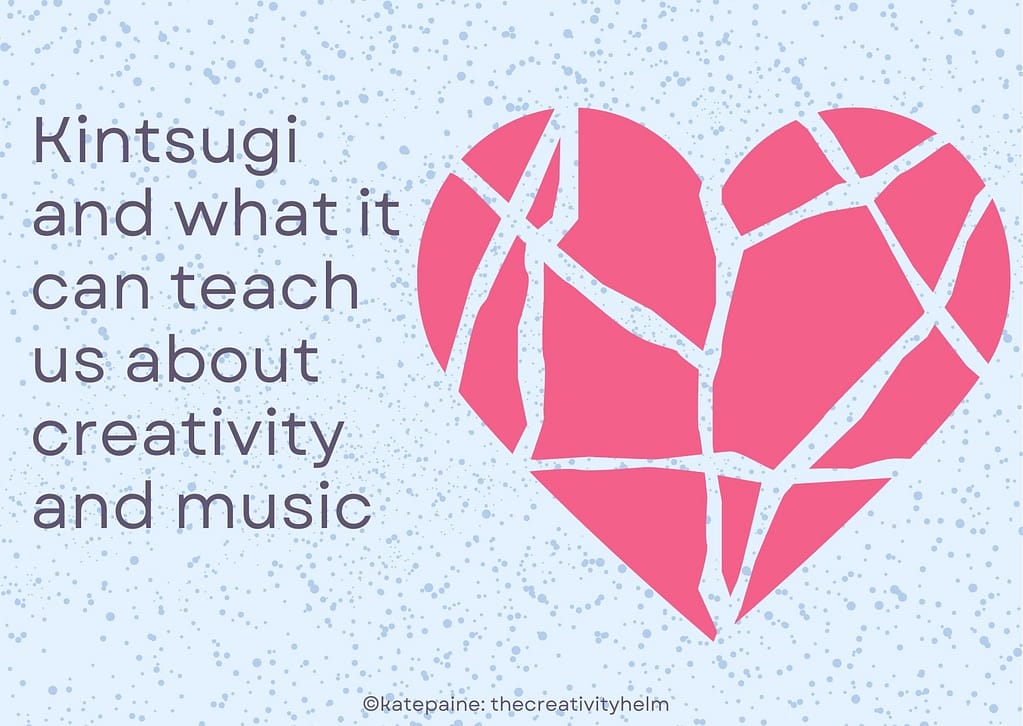
It turns out that when it comes to treasuring broken vases instead of lamenting their fall, my parents were in very good company. Starting in the fifteenth century, kintsugi, is the Japanese art of transforming broken pottery into something beautiful, cracks and all.
Instead of trying to hide cracks, the fragments are mended with a mix of lacquer and silver, platinum, or gold, so that it looks like golden veins are running through the pottery.
It’s a deliberate embracing of imperfection, a celebration of flaws instead of a rush to hide them. It creates something new from something that was broken, highlighting the transition from one to the other in the process.
The bowl becomes a story full of not only failure but also transformation, one of repair and renewal.
And I believe we should be thinking about music and creativity in the same way.
Music is already made up of fragments. Stir together melody, rhythm, harmony, and words (if it’s a song), and you already have a potent mix. But the magic really happens when you throw in the contribution of the people performing the music.
Some of it is their decisions around how slow or fast and how loud or soft throughout, but a huge part of it is the feel of a piece of music, the expression and emotion they put into it.
And then there are the mistakes.
While we’d prefer to not make any mistakes at all, they’re an inevitable part of being a musician, no matter how skilled and experienced you might be. The key is in how you react when they do happen, and in not letting the possibility of mistakes stop you from making music.
We can become so fearful of making a mistake that it stops us from creating anything at all. But do that and we miss out on that imperfectly imperfect beauty that comes from seeing mistakes and failure as an integral part of the whole, just like the seams in the kintsugi.
Take out the human component, no matter how flawed it can be, and you’re left with music that is soulless in comparison.
And in practice?
Listening
Next time you listen to a piece of music or song, see if you can identify the elements that go together to form the whole, including the contribution of the musician(s).
To take it further, see if you can find a few different versions of the same piece of music or song and listen to see how it has been interpreted differently.
Playing music
If you’re playing or singing yourself then you’re the one in charge of the narrative, and that includes being in control of how you think about and manage the mistakes that will inevitably happen.
This is a high priority in my teaching studio. While we work on technique and all the rest to eliminate mistakes, we also practice keeping on going no matter what happens.
Other times we practice seeing what we can do in response to a mistake, embracing it and turning it into an opportunity to try something different.
It’s not easy, especially at first, but so worth it when you realise that you’re the one with the power and the flexibility to adapt and make the most of whatever happens, to turn something unexpected into something beautiful.
And once you realise you have the ability and the flexibility to do this, it opens up a whole new world of possibilities for interpretation.
And creativity?
The same thing applies.
No matter what you’re doing there will always be mishaps and mistakes and unexpected forces at play.
But if you can see them as opportunities for transformation, for telling a story, you’ll put the pieces together in such a way that you create something beautiful.
Just like a kintsugi bowl with its seams of gold or silver.

0 Comments